Sigildry#
Sigildry is the creation of glass and clay items and both the application of sigils and the creation of exotic armor. Sigils may only be applied to armor and alter armor class. An item may only have one sigil. Glass can be created from sand or salvaged from existing glass equipment.
Melting of Material#
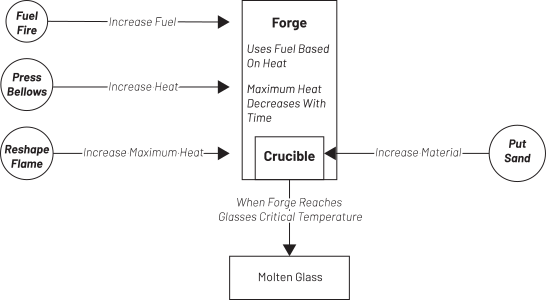
The first phase starts with taking sand and processing it into a melted form so it can be used to form glass later. In order to melt sand in the crucible the forge needs to be heated up to sands critical point. The forge is heated up by pressing the bellows. The hotter the forge the more fuel it consumes. When the fuel depletes the forge will gradually decrease in heat until it reaches room temperature. Over time the maximum heat of the forge decreases as fuel is consumed so occasionally the sigil inscriber will need to have to reshape the flame. The ore won’t be able to melt when reaching the critical temperature unless a purifying agent is introduced.
Creating Glass Product#
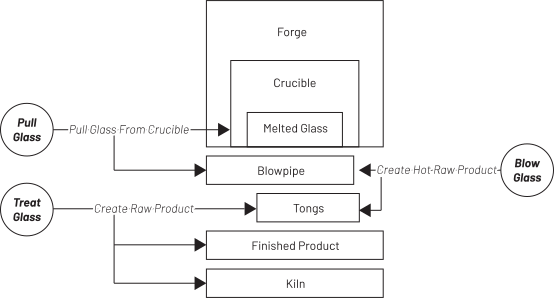
The last phase is where the molten glass is turned into the final product. The glass is first pulled from the crucible with a blowpipe. The blowpipe is twisted and then air is pushed through it in a process called blowing glass that will create a hot raw product of the desired shape. Before the product is considered finished, it must be let to cool down inside of a kiln. A kiln helps protect the product from rapidly cooling which would cause it to shatter or have inconsistent brittleness.
Creating Clay Product#
Creating clay products is very simple compared to glass melting and blowing. The tradesperson merely uses raw clay product to form an item atop a pottery wheel, uses a wire tool to cut that form off the wheel and moves it into a kiln so it can be fired until dry and finished.

Materials#
| Name | Description |
|---|
| clay | clay is molded by hand into perspective shapes in the effort to create wax cut, or permanant molds. |
| blowpipe | a blowpipe is a metallic hallow pipe used to push air into glass, allowing molten glass to expand into a shape. |
| pottery wheel | the pottery wheel is where clay forms are created before they are cut with a clay wire tool and moved to a kiln to be fired and finished. |
| clay wire tool | the wire tool allows the sigildry tradesperson to cut a clay form from atop a pottery wheel so it can be moved to a kiln. |
| blacksmith hammer | specialized hammer used within the blacksmithing tradesguild to form weapons, armor and other items. |
| forge | helps in heating of materials contained as ingots into molds by melting them into a liquid state. |
| hearth | very similar to a forge, a hearth is a smaller version where the crucible actually sets ontop instead of within. a hearth heats up to melt the material within the crucible. |
| tongs | tongs are metallic tools that bend at the top apex, allowing the tips to clamp and surface with the continued force of squeezing the handles together. tongs are used to hold very hot items, predominately those that need to be transported to the quench tank to cool. |
| mandrel | device needed to shape jewelry. |
| kiln | used to treat glass by protecting it from rapidly cooling. |
| brush | an implement with a handle, consisting of bristles set into a block used for cleaning or scrubbing a surface. |
| acrylic paint | used to paint leather. |
Skills#
| Name | Description |
|---|
| fuel fire | Issues coal into a hearth or forge. |
| press bellows | Increases the heat of the hearth or forge by forcing air into it (forge) or upon it (hearth) through a Tuyere. |
| reshape flame | Increases the maximum heat potential by assembling a new layer of damp coal around the edge of the earth or forge. |
| pull glass | Pulls glass tub out of the forge and pours into the mold. |
| blow glass | Pushes air into the glass through the pipe forming the glass object. |
| treat glass | Finishes the glass form and destroys the rest of the clay mold. |
| identify magic | Identifies any magical item detailing its magical properties, including elemental properties. |
| deduce mold | Create a mold using an existing item, sand, forge and crucible |
| paint sigil | Use a brush and paint to create sigils of power |
| exotic assembly | Assemble exotic items together using a sigil |
Glass Items#
| Name | DC | Required Mats |
|---|
| ampoule | 2 | 2 |
| vial | 4 | 3 |
| tube | 6 | 4 |
| erlenmeyer flask | 8 | 5 |
| florence flask | 10 | 6 |
| fleaker | 10 | 7 |
| spyglass | 10 | 4 |
Clay Items#
| Name | DC | Required Mats |
|---|
| tankard | 8 | 5 |
| pitcher | 10 | 8 |
| stein | 10 | 7 |
| pot | 5 | 13 |
| cooking pot | 5 | 13 |
| food bowl | 5 | 13 |
| food plate | 5 | 7 |
| kettle | 5 | 13 |
| weighted dice | 18 | 8 |
| dice | 15 | 8 |
| ocarina | 19 | 15 |
| pipe | 10 | 8 |
| whistle | 10 | 4 |
Exotic Items#
| Name | DC | Required Mats |
|---|
| hauberk | 20 | 80 |
| brigandine armor | 20 | 71 |
| lorica segmentata | 24 | 84 |
| lamellar | 21 | 77 |
| heater shield | 10 | 61 |
| kite shield | 12 | 58 |
Assembled Materials#
| Name | DC | Description |
|---|
| sequin | 10 | A sequin. |
| millefiori | 10 | A millefiori. |
| chevron beads | 15 | A chevron beads. |
| cinnabar beads | 15 | A cinnabar beads. |
| dragon scale | 20 | A dragon scale. |
| wyrm scale | 25 | A wyrm scale. |
| chitin | 20 | A chitin. |
| amber | 20 | An amber. |